
More Information
Submitted: June 29, 2026 | Accepted: July 06, 2026 | Published: July 07, 2026
Citation: Palaniappan P, Rajesh Kumar Kodali V, Thamarai Selvi K. Efficacy of Intraperitoneal 0.25% Levobupivacaine for Postoperative Analgesia Following Laparoscopic Cholecystectomy: A Prospective Randomised Double-blinded Controlled Trial. Int J Clin Anesth Res. 2026; 10(1): 4-8. Available from:
https://dx.doi.org/10.29328/journal.ijcar.1001037
DOI: 10.29328/journal.ijcar.1001037
Copyright license: © 2026 Palaniappan P, et al. This is an open access article distributed under the Creative Commons Attribution License, which permits unrestricted use, distribution, and reproduction in any medium, provided the original work is properly cited.
Keywords: Levobupivacaine; Laparoscopic cholecystectomy, Postoperative analgesia; Intraperitoneal instillation

Efficacy of Intraperitoneal 0.25% Levobupivacaine for Postoperative Analgesia Following Laparoscopic Cholecystectomy: A Prospective Randomised Double-blinded Controlled Trial
Pavithra Palaniappan, Rajesh Kumar Kodali V* and Thamarai Selvi K
Department of Anesthesiology, Sri Ramachandra Institute of Higher Education and Research (SRIHER), Tamil Nadu, India
*Address for Correspondence: Pavithra Palaniappan, Senior Resident, Department of Anesthesiology, Sri Ramachandra Institute of Higher Education and Research (SRIHER), Tamil Nadu, India, Email: [email protected]
Laparoscopic cholecystectomy, though associated with reduced postoperative pain compared to open surgery, often necessitates effective pain management for residual visceral and referred pain. This study aimed to evaluate the efficacy of intraperitoneal instillation of 0.25% levobupivacaine in providing postoperative analgesia, focusing on time to first analgesic request and pain control compared to normal saline.
Methods: A prospective, randomised, double-blind controlled trial was conducted involving 58 adult patients undergoing elective laparoscopic cholecystectomy. Participants were randomised to receive either 30 mL of 0.25% levobupivacaine (Group A) or 30 mL of normal saline (Group B) intraperitoneally at the end of the surgery. Pain scores were assessed using the Visual Analogue Scale (VAS) in different positions at predetermined intervals. Primary and secondary outcomes were time to first analgesic request and total number of analgesic doses used in the first 24 hours, respectively. Data were analysed with SPSS software (ver. 23), and p - value < 0.05 was considered significant.
Results: The time to first analgesic request was significantly longer in Group A (Median: 240.0 mins, IQR: 153.8) compared to Group B (Median: 135.0 mins, IQR: 138.8; p = 0.025). VAS scores during coughing were significantly lower in the levobupivacaine group at 0 minutes, 15 minutes, 30 minutes, 1 hour, and 2 hours postoperatively (p < 0.05). Total number of analgesic doses used in the first 24 hours was lower in Group A, though not statistically significant.
Conclusion: Intraperitoneal 0.25% levobupivacaine demonstrates significant efficacy in reducing postoperative pain following laparoscopic cholecystectomy, making it a valuable tool in multimodal analgesia strategies aimed at improving recovery experiences for patients undergoing this common surgical procedure.
Laparoscopic cholecystectomy is widely preferred over open cholecystectomy due to reduced postoperative pain, faster recovery, and shorter hospital stays [1]. However, pain following laparoscopic procedures, particularly visceral and referred pain, can still be significant, necessitating effective pain management strategies [2]. Intraperitoneal instillation of local anaesthetics has been explored to mitigate these pain components, potentially improving patient outcomes by reducing the need for systemic analgesics and their associated adverse effects [3].
Levobupivacaine, the S-enantiomer of bupivacaine, offers a safer pharmacological profile with lower risks of cardiotoxicity and neurotoxicity. Its efficacy in providing postoperative analgesia through intraperitoneal administration has been demonstrated in various clinical settings but warrants further investigation in the context of laparoscopic cholecystectomy [4].
Despite existing evidence supporting the use of local anaesthetics for postoperative pain relief, there remains a paucity of data on the specific effects of intraperitoneal levobupivacaine in laparoscopic cholecystectomy. This study intends to bridge this knowledge gap by assessing its efficacy compared to a placebo, focusing on pain control and time to first analgesic request. The study aimed to evaluate the efficacy of intraperitoneal 0.25% levobupivacaine for postoperative analgesia following laparoscopic cholecystectomy.
This was a prospective, randomised, double-blind controlled trial conducted over a period of seven months (August 2019 to February 2020) in the Department of Anaesthesiology and Pain Medicine at a Tertiary Care Hospital. A sample size of 23 per group was calculated from a pilot study, based on standard deviations of 2 and 1.4 with a mean difference of 2.5 in group A (levobupivacaine) and group B (normal saline), respectively, using time for first request of analgesia as the primary outcome to achieve 99% power at a 1% significance level. To account for a 20% non-participation rate, 28 participants per group were enrolled. The study population included adult patients aged 18 to 60 years who were scheduled to undergo elective laparoscopic cholecystectomy and classified as American Society of Anaesthesiologists (ASA) physical status I or II. Participants were excluded if they declined participation, had a known allergy to local anaesthetics, presented with severe cardiac, pulmonary, or neurological disease, weighed less than 50 kg, required conversion to open cholecystectomy during the procedure, or received placement of an abdominal drain during surgery.
Following approval from the Institutional Ethics Committee (Approval No. IEC/19/JUN/151/28), the study was registered in the Clinical Trials Registry of India (CTRI/2019/08/020837). After obtaining written informed consent, Participants were randomised into two groups (Group A: 0.25% levobupivacaine; Group B: normal saline) using computer-generated random numbers. Allocation was concealed using sequentially numbered, opaque, sealed envelopes prepared by an anaesthesiologist not involved in patient recruitment or outcome assessment. Study solutions were prepared by an anaesthesiologist not involved in the study to ensure blinding of both participants and investigators.
Patients underwent standard monitoring, including continuous electrocardiography, noninvasive blood pressure (systolic, diastolic and mean arterial pressure), and pulse oximetry, and baseline vital signs were recorded before anaesthesia induction, with fentanyl, propofol, and vecuronium, followed by tracheal intubation. Anaesthesia was maintained with air, oxygen, sevoflurane, and intermittent vecuronium, with ventilation adjusted for normocapnia. A nasogastric tube was inserted. Hypotension and bradycardia were managed with appropriate medications. Patients were positioned in reverse Trendelenburg with left tilt, and intraabdominal pressure was maintained at 12-14 mmHg during laparoscopy. At the end of the surgery, before trocar removal, 30 mL of the study solution was instilled intraperitoneally. Group A received 0.25% levobupivacaine, and Group B received normal saline. The solution was administered to the upper liver surface, right subdiaphragmatic space, gallbladder bed, and hepatoduodenal ligament by trained surgeons under the supervision of the principal investigator.
The time elapsed until the first postoperative analgesic request was documented. Further pain assessment via Visual Analogue Scale (VAS) scores, measured in supine, sitting, and coughing positions at specified time points, and the total number of analgesic doses used in the first 24 postoperative hours were recorded.
The collected data were analysed using IBM SPSS (version 23.0). Continuous variables were assessed for normality using the Shapiro–Wilk test. Normally distributed continuous variables are presented as mean (standard deviation) and were compared between groups using the unpaired t-test. Non-normally distributed continuous variables, including VAS scores, are presented as median (interquartile range) and were compared using the Mann–Whitney U test. Categorical variables are expressed as frequencies and percentages and were compared using the Chi-square test. A p - value < 0.05 was considered statistically significant.
A total of 65 patients were assessed for eligibility. Seven patients were excluded due to not meeting inclusion criteria (n = 5) or declining participation (n = 2). Fifty-eight patients were randomised equally into two groups (Group A: 29; Group B: 29). Two participants were excluded due to conversion of the laparoscopic procedure to an open procedure; the rest all other participants completed the study, and no follow-up data were lost (Figure 1).
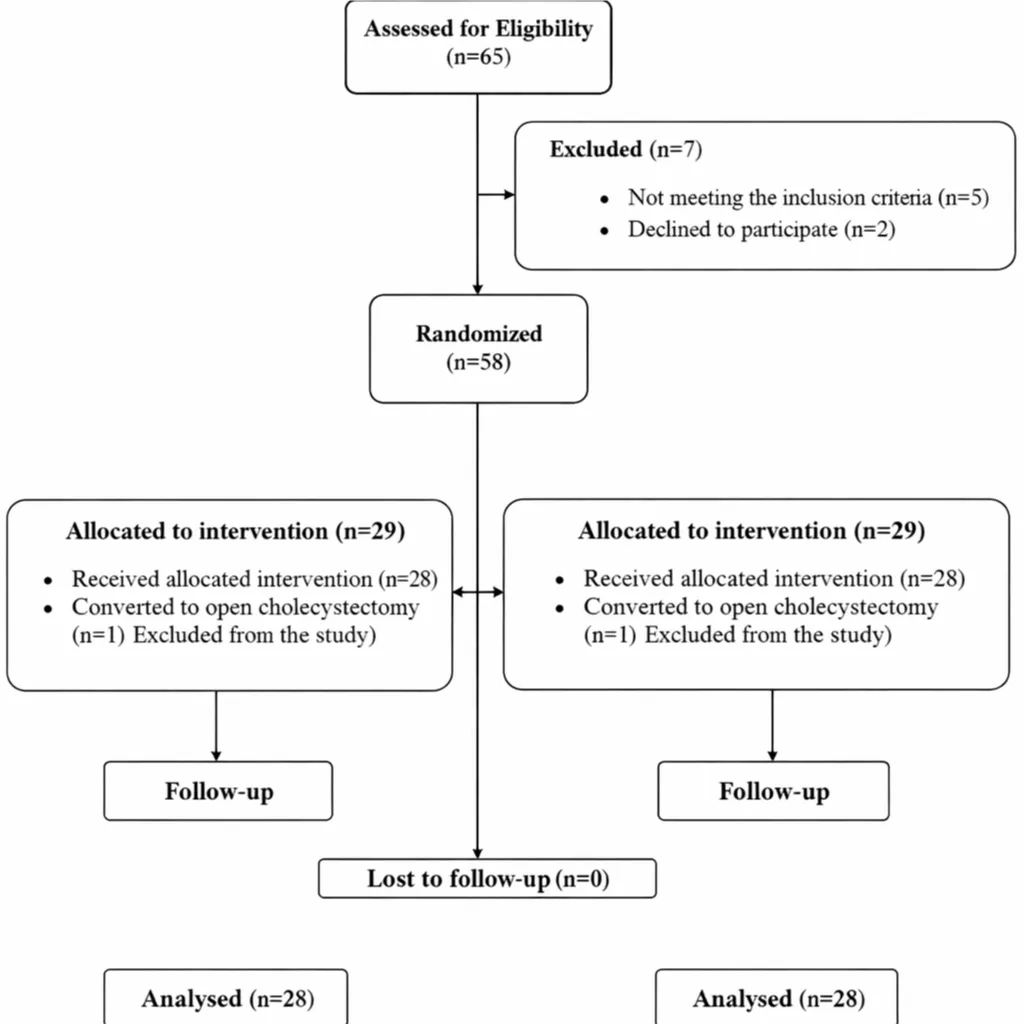
Figure 1: Study participant flow.
Baseline characteristics
Baseline demographic and clinical characteristics, including age, gender, and ASA status, were comparable between the two groups, with no statistically significant differences observed (Table 1). Also, the mean (SD) weight of the Group A and Group B patients was found to be 67.7 + 7.1 and 67.7 + 6.9, respectively.
| Table 1:Baseline characteristics of the study population. | ||||
| Characteristics | Group | Total n(%) |
p - value | |
| Group-A n(%) | Group-Bn(%) | |||
| Age | ||||
| Up to 20 years | 0 | 1 (3.6) | 1 (1.8) | 0.387 |
| 21-30 years | 4 (14.3) | 6 (21.4) | 10 (17.9) | |
| 31-40 years | 10 (35.7) | 6 (21.4) | 16 (28.6) | |
| 41-50 years | 9 (32.1) | 6 (21.4) | 15 (26.8) | |
| 51-60 years | 5 (17.9) | 9 (32.1) | 25 (56) | |
| Gender | ||||
| Male | 11 (39.3) | 11 (39.3) | 22 (39.3) | 1 |
| Female | 17 (60.7) | 17 (60.7) | 34 (60.7) | |
| ASA | ||||
| I | 17 (60.7) | 17 (60.7) | 34 (60.7) | 1 |
| II | 11 (39.3) | 11 (39.3) | 22 (39.3) | |
Time for 1st request of Analgesia
The median time to first analgesic request was significantly longer in Group A (Median: 240.0 mins, IQR: 153.8) compared to Group B (Median: 135.0 mins, IQR: 138.8; Mann-Whitney p = 0.025).
VAS scores
Group A demonstrated significantly lower VAS scores during coughing at 0 minutes (p = 0.0044), 15 minutes (p = 0.0115), 30 minutes (p = 0.0005), 1 hour (p = 0.0042), and 2 hours (p = 0.00440) compared to Group B. No significant differences were noted in supine or sitting positions.
Analgesic usage
Total analgesic doses did not differ significantly between Group A (Median: 2.0, IQR: 0.0) and Group B (Median: 2.0, IQR: 1.0; Mann-Whitney p = 0.198).
Gas insufflation and elevated intraperitoneal pressure promote peritoneal inflammation and neuronal rupture in laparoscopic procedures, with a linear connection between abdominal compliance and the degree of postoperative pain [5].
The immediate postoperative pain following laparoscopy can be attributed to multiple factors, including abdominal wall trauma, distension, and abdominal and diaphragmatic irritation as a result of pneumoperitoneum using CO2 [6].
Levobupivacaine exerts its local anaesthetic effect by inhibiting sodium channels in nerve fibres, thereby inhibiting the transmission of pain signals from the surgical site to the central nervous system. This nerve blockade also contributes to a reduction in the inflammatory response triggered by surgical trauma. Intraperitoneal administration of levobupivacaine offers prolonged analgesia compared to other administration routes. Furthermore, this method minimises systemic absorption of the drug, thus reducing the potential for systemic side effects [7].
The study demonstrated the efficacy of intraperitoneal instillation of 0.25% levobupivacaine in providing postoperative analgesia for laparoscopic cholecystectomy. Patients in the levobupivacaine group (Median: 240.0 mins, IQR: 153.8) had experienced a significantly longer time to the first analgesic request compared to the control group (Median: 135.0 mins, IQR: 138.8). These findings can be supported by the existing observations of Butala, et al. [8], where women undergoing laparoscopy for gynaecology procedures instilled intraperitoneal levobupivacaine with morphine, which resulted in significantly delayed time before the first rescue analgesia and lowered overall consumption of analgesia in 24 hours postoperatively. Further, Shukla, et al.
[9] demonstrated that the time to first request analgesia in bupivacaine-administered patients was 55 ± 18 min, which can be attributed to site-specific levobupivacaine instillation, intermittent boluses of fentanyl every hour, and paracetamol before extubation. In the study conducted by Putta, et al, the time to first request analgesia following the surgery among the patients who received 30 ml of 0.5% Bupivacaine intraoperatively was 337.5 ± 97.5 minutes [10]. Similarly, findings of Das, et al. showed that the duration of analgesia was 13.47 ± 1.38 hours in Group R (35 ml of 0.375% ropivacaine), 7.93 ± 1.44 hours in Group B (35 ml of 0.25% bupivacaine) and this longer duration of analgesia can be because higher volumes of local anaesthetics were used and intravenous paracetamol and diclofenac were given intraoperatively [11].
In our study, patients who received levobupivacaine demonstrated significantly lower VAS scores during coughing at 0 minutes, 15 minutes, 30 minutes, 1 hour, and 2 hours. Cunningham et al had compared the post-laparoscopic pain with intraperitoneal instillation of levobupivacaine and 0.9% sodium chloride, where the levobupivacaine group showed a significant reduction in pain till 8 hours [4].
In contrast to our findings, a study conducted by El-Labban, et al. showed that intra-incisional infiltration of levobupivacaine is more effective than the intraperitoneal route in the management of postoperative pain and VAS score in the group that received an intra-incisional levobupivacaine. This variation could be due to site-specific infiltration of levobupivacaine given by two trained surgeons in our study [12].
However, in the study conducted by Louizos, et al. [13], the patients who received intraperitoneal instillation and local infiltration of 20 mL 0.25% levobupivacaine each had higher VAS scores when compared to our study during coughing at 30 min, 4 hrs and 24 hrs after the procedure, whereas at 12 hrs after the procedure, the VAS score was lower when compared to our study. Further, on comparing with the VAS scores of the Bupivacaine group in a study by Shukla, et al. [9], at 30 mins, 1 hour, 2 hours and 4 hours, these scores were notably higher when compared to the levobupivacaine group in our study. In the study conducted by Pasqualucci, et al. [14], the VAS scores in patients who received saline before dissection and bupivacaine after dissection at various time intervals were higher than in our study. These discrepancies can be attributed to the application of multimodal analgesia to avoid adverse effects of individual drugs in our study. Furthermore, Kucuk, et al. demonstrated that intraperitoneal instillation of ropivacaine at the end of laparoscopic cholecystectomy significantly reduced postoperative pain in comparison to bupivacaine, but no significant variations were observed between the groups in the analgesia, as assessed by VAS scores at rest, on coughing and during mobilization [15]. Also in our study, total analgesic usage in 24 hours was lower in the Levobupivacaine group in comparison with the control group, but it was not statistically significant.
Further, Jain N et al had shown that addition of adjuvants such as clonidine to levobupivacaine prolongs the duration of analgesia and decreases overall opioid consumption postoperatively, highlighting a synergistic effect that may improve patient outcomes [16].
The safety profile of intraperitoneal levobupivacaine is favourable. Studies report minimal side effects and complications associated with its use, making it a viable option for postoperative analgesia following laparoscopic procedures [17].
A robust prospective, randomised controlled trial design ensures a high level of evidence, which is further enhanced by blinded intervention, eliminating the potential observer and participant bias. Moreover, the comprehensive assessment of pain in supine, sitting, and coughing positions provides a detailed understanding of postoperative pain dynamics.
Limitations
The relatively small sample size and absence of comparison with other local anaesthetics, such as ropivacaine, or combinations with adjuvants limit the scope of the study. Further, long-term outcomes such as length of hospital stay and cost-effectiveness were not evaluated.
This study concludes that intraperitoneal instillation of 0.25% levobupivacaine effectively prolongs the time to the first analgesic request and significantly reduces VAS scores during critical postoperative periods, particularly during coughing. The use of intraperitoneal levobupivacaine offers a simple and effective strategy to enhance postoperative recovery in laparoscopic cholecystectomy. Future studies should explore the addition of adjuvants and their impact on long-term outcomes such as hospital stay and cost-effectiveness.
- Mehmood A, Mei SY. Laparoscopic cholecystectomy versus open cholecystectomy. World Journal of Biology Pharmacy and Health Sciences. 2024;17(2):396-404. Available from: https://doi.org/10.30574/wjbphs.2024.17.2.0097
- Macías AA, Finneran JJ. Regional anaesthesia techniques for pain management for laparoscopic surgery: a review of the current literature. Current Pain and Headache Reports. 2022 Jan;26(1):33-42. Available from: https://doi.org/10.1007/s11916-022-01000-6
- Das NT, Deshpande C. Effects of Intraperitoneal Local Anaesthetics Bupivacaine and Ropivacaine versus Placebo on Postoperative Pain after Laparoscopic Cholecystectomy: A Randomised Double Blind Study. J Clin Diagn Res. 2017 Jul;11(7): UC08-UC12. Available from: https://doi.org/10.7860/JCDR/2017/26162.10188
- Cunningham TK, Draper H, Bexhell H, Allgar V, Allen J, Mikl D, et al. A double-blinded randomised controlled study to investigate the effect of intraperitoneal levobupivacaine on post-laparoscopic pain. Facts, views & vision in ObGyn. 2020 Sep;12(3):155.
- Tobias JD. Pain management following laparoscopy: Can we do better? Saudi J Anaesth. 2013 Jan 1;7(1):3–4. Available from: https://doi.org/10.4103/1658-354X.109553
- Kaloo P, Armstrong S, Kaloo C, Jordan V. Interventions to reduce shoulder pain following gynaecological laparoscopic procedures. Cochrane Database Syst Rev. 2019 Jan 30;2019(1):CD011101. Available from: https://doi.org/10.1002/14651858.CD011101.pub2
- Ahlawat G. A Comparative Evaluation of Intraperitoneal Subdiaphragmatic Instillation of Levobupivacaine versus Ropivacaine for Shoulder Tip Pain after Laparoscopic Cholecystectomy; a double blind placebo controlled study. International Journal of Medical Science and Diagnosis Research. 2018 Aug 28;2(4).
- Butala BP, Shah VR, Nived K. Randomised double blind trial of intraperitoneal instillation of bupivacaine and morphine for pain relief after laparoscopic gynaecological surgeries. Saudi J Anaesth. 2013;7(1):18–23. Available from: https://doi.org/10.4103/1658-354X.109800
- Shukla U, Prabhakar T, Malhotra K, Srivastava D, Malhotra K. Intraperitoneal bupivacaine alone or with dexmedetomidine or tramadol for post-operative analgesia following laparoscopic cholecystectomy: A comparative evaluation. Indian J Anaesth. 2015 Apr;59(4):234–9. Available from: https://doi.org/10.4103/0019-5049.155001
- Putta PG, Pasupuleti H, Samantaray A, Natham H, Rao MH. A comparative evaluation of pre-emptive versus post-surgery intraperitoneal local anaesthetic instillation for postoperative pain relief after laparoscopic cholecystectomy: A prospective, randomised, double blind and placebo controlled study. Indian J Anaesth. 2019 Mar 1;63(3):205–11. Available from: https://doi.org/10.4103/ija.IJA_767_18
- Das NT, Deshpande C. Effects of Intraperitoneal Local Anaesthetics Bupivacaine and Ropivacaine versus Placebo on Postoperative Pain after Laparoscopic Cholecystectomy: A Randomised Double Blind Study. J Clin Diagn Res. 2017 Jul;11(7): UC08-UC12. Available from: https://doi.org/10.7860/JCDR/2017/26162.10188
- El-labban GM, Hokkam EN, El-labban MA, Morsy K, Saadl S, Heissam KS. Intra-incisional vs intraperitoneal infiltration of local anaesthetic for controlling early post-laparoscopic cholecystectomy pain. J Minim Access Surg. 2011;7(3):173–7. Available from: https://doi.org/10.4103/0972-9941.83508
- Louizos AA, Hadzilia SJ, Leandros E, Kouroukli IK, Georgiou LG, Bramis JP. Postoperative pain relief after laparoscopic cholecystectomy: A placebo-controlled double-blind randomised trial of preincisional infiltration and intraperitoneal instillation of levobupivacaine 0.25%. Surg Endosc. 2005 Nov 1;19(11):1503–6. Available from: https://doi.org/10.1007/s00464-005-3002-4
- Pasqualucci A, Contardo R, Da Broi U, Colo F, Terrosu G, Donini A, et al. The effects of intraperitoneal local anaesthetic on analgesic requirements and endocrine response after laparoscopic cholecystectomy: a randomised double-blind controlled study. J Laparoendosc Surg. 1994 Dec;4(6):405–12. Available from: https://doi.org/10.1089/lps.1994.4.405
- Kucuk C, Kadiogullari N, Canoler O, Savlı S. A Placebo-Controlled Comparison of Bupivacaine and Ropivacaine Instillation for Preventing Postoperative Pain After Laparoscopic Cholecystectomy. Surg Today. 2007 May 1;37(5):396–400. Available from: https://doi.org/10.1007/s00595-006-3408-1
- Jain N, Sethi SK, Soni B, Patodi V, Jain K, Garg DK. A comparative study to evaluate the efficacy of intraperitoneal instillation of 0.25% levobupivacaine with or without clonidine (0.75 μg/kg) for postoperative analgesia in patients undergoing laparoscopic cholecystectomy. Journal of Dr NTR University of Health Sciences. 2022 Jan 1;11(2):126–33.
- Alper I, Ulukaya S, Ertuğrul V, Makay Ö, Uyar M, Balcıoğlu T. Effects of intraperitoneal levobupivacaine on pain after laparoscopic cholecystectomy: a prospective, randomised, double-blinded study. AGRI. 2009; 21(4): 141-145